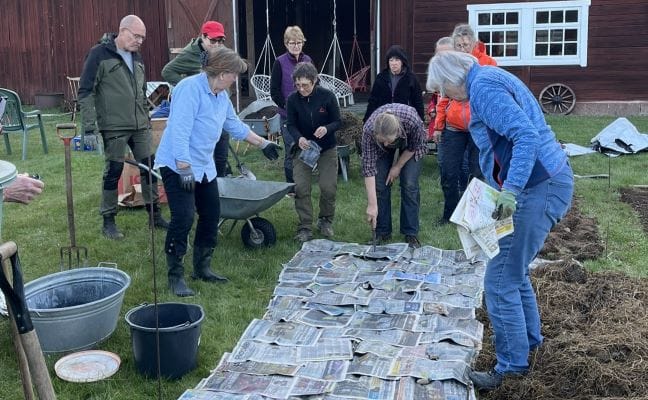
There are many ways to transform a lawn into a flourishing garden bed. In a workshop with JUF Hycklinge Odlargrupp, the Odlingsakademien course leader Hillevi Helmfrid tested six methods that all start from the soil that is already in place. The evening was an activity within Odlingsakademien 3.0 and a continuation of lectures with Hillevi in Kisa on March 26 and in Hycklinge on April 28.
15 people participated in this practical workshop.
A more detailed description of the different methods with their pros and cons will be published in a series of blog posts, and eventually described more thoroughly in a document.
Here we have gathered some pictures from the evening at Härna Nedergård.
This is how the result of the evening's work turned out (the pallet boxes were not included in the workshop):

The compost heap at the back left consists of branches and twigs, grass turfs, manure, silage, and grass clippings. It has received its planting holes, which have been filled with well-rotted cow manure. Ready to plant pumpkin plants that will cover the entire heap.
The deeply dug area at the front left has been shaped into two beds covered with grass clippings, and the path between the beds is covered with old silage. The beds are waiting to be sown or planted.
Furthest to the right, one section consists of potato cultivation in upturned elongated grass turfs, and the other is potato cultivation on newspapers on the lawn. Both are covered with old silage, so no difference is visible in this picture.
Furthest to the front right is a section of upside-down grass turfs waiting for planting (in the seams) and then covered with grass clippings. The other section is simply covered with black plastic. It will be put to use next year. By then, the grass will have died, and the nutrients in the grass sod will have been made available. For those who want to create a large garden bed, cultivation on newspapers and black plastic are the methods for the large areas as they require the least work. But a compost heap in progress should simultaneously exist in every garden as it is a simple way to utilize garden waste.
When we started, there was already a garden bed that was 2×6 meters. The goal was to expand to 4.4×6 meters. The left picture shows the target image with two times four beds that are 80 cm wide to allow for an eight-year crop rotation. The right picture shows where we applied the different methods.

The different methods determine what can be grown this year (left picture). In the long run, everything can be grown everywhere, and an eight-year crop rotation can be applied (right picture).

The most labor-intensive method is deep digging. We chose to do it where the soil was already bare to improve the soil quality. Deep digging is a one-time action to restore tired soil.

Turning over a grass turf over two meters long over a row of potatoes is clever but turned out to be heavier than we had imagined.

The compost heap was easy to build. There was plenty of garden waste that had been taken away but could be retrieved. The planting holes are made with iron stakes in the first year. In the coming years, that task becomes easier as the heap composts.

A much-needed coffee break for hard workers and an opportunity for networking.

After the coffee break, the easy job remained. Here, potato cultivation is being prepared on newspapers on the lawn. New energy and activity.

In the end, everything is covered in a lovely layer of old silage.

Thank you Ann-Christine and Per Erik for providing space and materials. It will be exciting to follow the evaluation of the different methods!