On several of the garden visits we have talked about shrubs and trees. Both taking stock of what is available and what might be suitable to plant. Examples of shrubs with edible berries are currants, gooseberries, blackberries, black raspberries, American blueberries, blueberry bushes, chokeberries, elderberries, rose hips, sea buckthorn, hazel, large-fruited hazel and berry medlar. Most shrubs can either be planted as free-growing or tied up in trellises. Some can also be staked. Larger shrubs, such as sea buckthorn, can be used to break the wind and create a better microclimate.
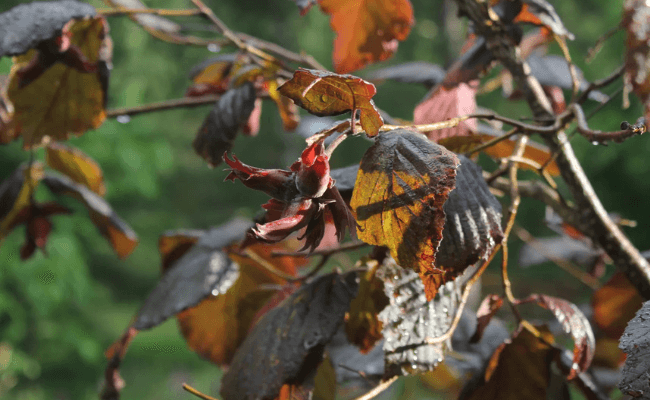
Large-fruited hazel. It is good to have bushes of different varieties to get larger harvests. The same goes for American blueberries and blueberry bushes. With sea buckthorn, it is better to have both males and females. One male can service up to seven females.
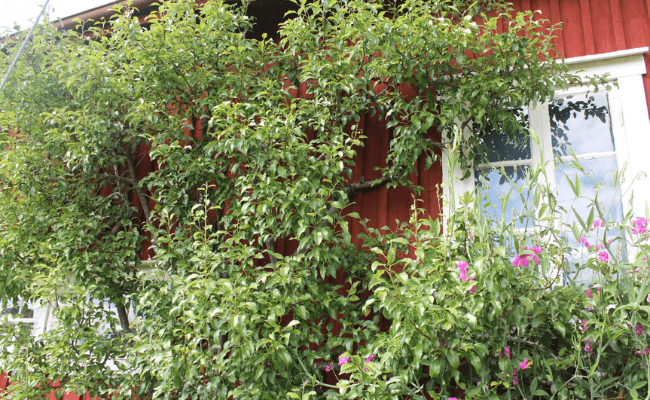
Trees can also be trellised. A wall can create a good microclimate, but it is often better to choose a west-facing wall than one facing due south. If it is too warm, there is a risk that the tree will bloom too early in the spring, resulting in frost damage.
Something we talked about on a garden visit was that it can be smart to plant your trees (and shrubs) in different places to increase the chance of something bearing fruit in years with late frost. In other words, apply the method of not ”putting all your eggs in one basket”.
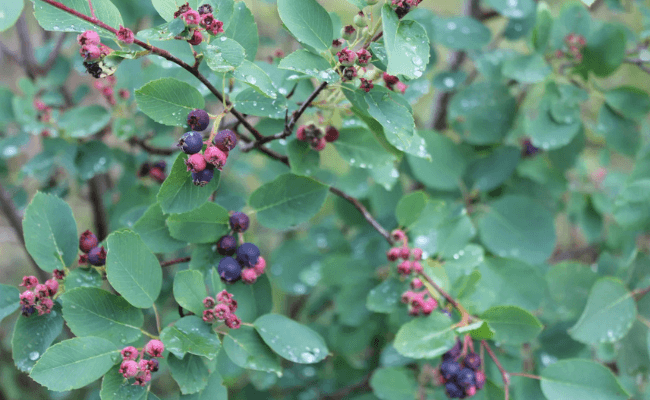
American blueberries like acidic soil. It is often recommended to buy peat, but it is not so good for the climate. It should be possible to use semi-composted material from the coniferous forest instead or sawdust. I personally use wet sawdust from the stable. Some horse owners use peat to sprinkle with instead of sawdust – reuse it rather than buy new!
Many shrubs are excellent for taking cuttings or making offshoots from. Currants, gooseberries, blackberries and blueberries are easy, while American blueberries and hazel are more difficult. Raspberries spread easily, so with a little patience, a few plants will become many. Let the garden take its time and you will save both the environment and your wallet.
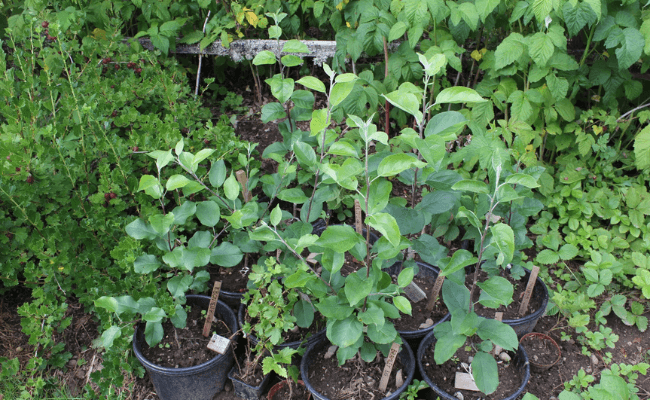
Fruit trees should be grafted instead. It is possible to grow rootstocks to graft onto from seeds, but if you want a certain type of fruit, you must graft branches because the seeds produce fruit with completely different characteristics than the mother plant. It is fine to take the cuttings yourself in the spring-winter or you can buy both rootstocks and cuttings in the spring. For trellising, choose weak-growing rootstocks and for free-growing trees, choose strong-growing ones.
Raspberries should not be planted near the garden plot, as they spread easily. The roots have no problem getting under garden paths and the like. It is better to place the raspberry plot in the middle of the lawn so that you can cut down any shoots that escape. Distinguish between summer and autumn raspberries, as they should be pruned differently.