Just as we wrote in last week's post, Astrid Lindgren's Hembygd has worked on sustainability and transition issues in several program periods. Several of us on the board and previous project leaders were passionate about the subject but realized that we had not succeeded in reaching out. Perhaps we were too early? The experience from the project Future Forum was that the more concrete we were, the better. Cultivation turned out to be the best entry point to talk about transition, cycles, and what an individual can do to influence the big questions in the small.
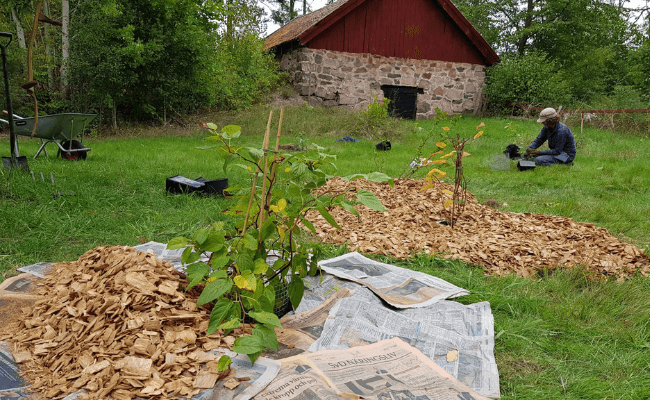
Forest garden course in Högsby September 9, 2018.
In late summer 2018, Astrid Lindgren's Hembygd board members Carina Engqvist and Kristina Lindelöf coincidentally ended up in the same course as former project leader Hillevi Helmfrid. The topic of the day was forest garden cultivation and the course leader was Philip Weiss. In the car on the way home, an idea was born that, after an intense processing, led to the project The Cultivation Academy.
The idea was to utilize all the knowledge that exists – in the form of experienced growers/course leaders, hired speakers, and study and farm visits – to give it to people in the area and inspire them to spread the knowledge further. In the long term, such a project could contribute to a more resilient society, where people have knowledge, conditions, and the will to produce more vegetables locally.
Early autumn 2018, a couple of smaller surveys were conducted to gauge interest in cultivation courses. The project was prioritized as a LAG-owned project in Astrid Lindgren's Hembygd and started in December of the same year. Three course leaders were tied to the project: Ola Johansson, Mariannelund, Eva Ekenberg, Eksjö, and Hillevi Helmfrid, Vimmerby. Helena Styrbjörn was hired as the project coordinator and became responsible for the blog, among other things. Carina Engqvist and Kristina Lindelöf became the board's representatives and also participated in planning and implementation.
Three courses were developed:
Cultivation course Create your own utility garden
Cultivation course Cultivation as a lifestyle
Cultivation course Sustainable gardening
The courses had different focuses, designs, and levels of ambition. The most advanced included homework and corresponded to 20 percent study pace. All three courses followed the cultivation year and had about one meeting per month.
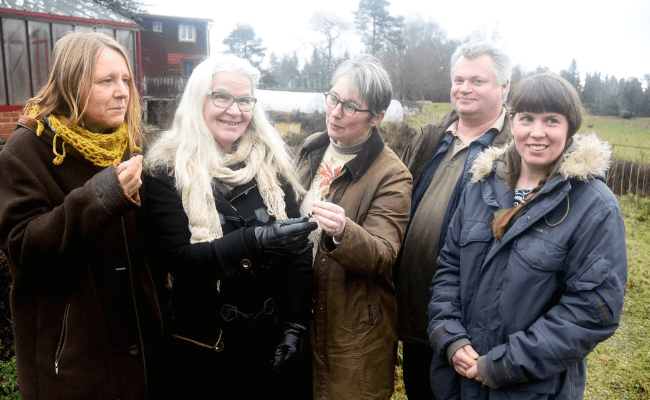
Image from the press conference at Ingebo Hagar. Hillevi Helmfrid, Eva Ekenberg, Kristina Lindelöf, Ola Johansson, and Helena Styrbjörn. Photo: Magnus Strömsten.
In connection with the first press conference at Ingebo Hagar, an announcement of the courses was made. The interest was far beyond expectations! About 100 people submitted applications! We understood that the time was ripe and that the residents of Astrid Lindgren's Hembygd longed for more knowledge about cultivation.
The Cultivation Academy was born.
In October 2019, another announcement was made, this time there were ten cultivation tunnels in the pot. 26 applications were received and 10 recipients were selected, based on the criteria of competence, benefit to the area, opportunities to create jobs, and geographical distribution. During the spring of 2020, all tunnels were built and several of the recipients have shared their experiences here on the blog.
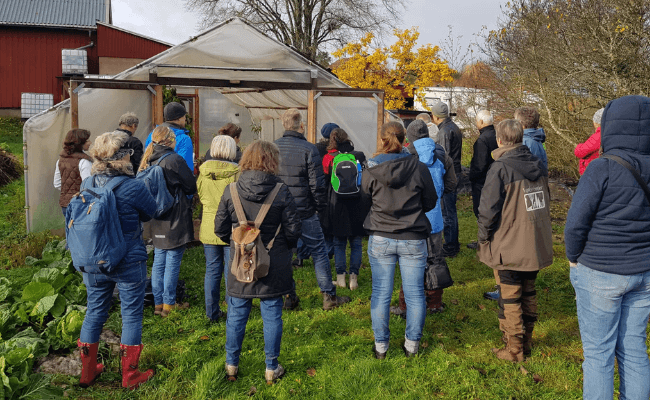
Inspiration meeting with Hillevi Helmfrid before the announcement of the tunnels.
Next Sunday, the story of the Cultivation Academy continues!
What has the Cultivation Academy meant for you? Please comment below or send an email to odlingsakademien@alhembygd.se
Your experiences of the project are valuable both for our evaluation and our opportunities to continue working with cultivation in our area in the future.
We wish you a nice week!
Kristina Lindelöf and Carina Engqvist
for the board of Astrid Lindgren's Hembygd