On Sunday, October 22, about 15 listeners gathered to learn more about planning and structuring cultivation. The speaker was Josefin Karlsson from Korka Kvarn, where the Cultivation Academy made a study visit in August. Perhaps Josefin's most important tip was to start from yourself, to find your own right way. What is important to you and what are your own problem areas? As an entrepreneur, it is important for Josefin to have a plan that allows her to get the most out of her time, space and resources. It is important to spend time on the right things at the right time to avoid unnecessary work and to spend money thoughtfully. For someone else, planning may revolve around cultivating despite a lack of water or physical pain. To plan her cultivation, Josefin starts at the other end - by defining what she wants to achieve. One way is to calculate how much harvest there will be and from what. How much cucumber does a family eat in a summer and how much should be stored for the winter? How many cucumber plants are needed to meet the need? Then she sows the number x 1.4 to have a margin for waste. To plant 12 cucumber plants, she sows 12 x 1.4 = 17 cucumber seeds. If you don't have the time and energy to go through all the vegetables and varieties to be grown, Josefin's advice is to focus on the top 5 most important ones. How much harvest you get per plant can be learned to some extent and the rest comes with experience. The actual outcome then of course depends on the conditions offered, such as the weather, for example, but with a good plan you can go a long way.
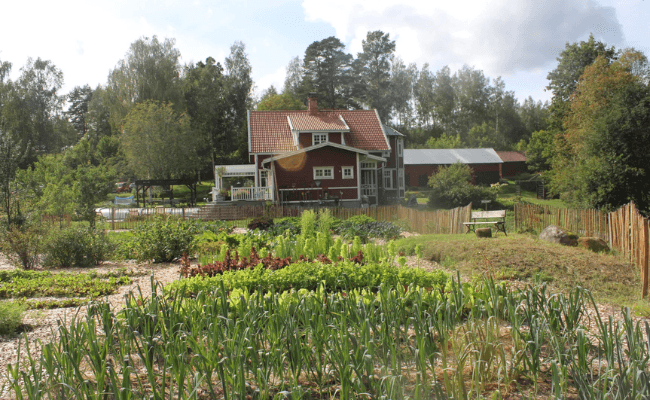
With a well-planned vegetable garden with growing beds that are to be filled in accordance with a crop rotation, Josefin instead plans the number of plants by carefully measuring and drawing out the garden (beds that are the same width and preferably the same length make it easier!). Using recommended row and plant spacing, she can calculate how many plants will fit in the bed and then how many to sow (x 1.4!). To make it easier, only one type of crop is usually grown per bed, sometimes a maximum of 2 varieties are co-grown per bed. When should you sow? Josefin warns against getting stressed when social media is flooded with early sowings and harvests, but recommends having ice in your stomach to reduce the workload - unless it is precisely tinkering with early plants that is your own cultivation interest. She uses 4 times for sowing: The early sowing of, for example, chili, celery root, seeded onions and artichokes, which takes place in February. The 8-week sowing (where the plants should be about 8 weeks old when transplanted) which is the tomatoes which are sown in mid-late March. The 4-week sowing for cold-resistant plants such as cabbage, lettuce, beets and peas which are sown in early-mid April to be planted out a month later and the 4-week sowing for heat-requiring plants such as corn, cucumbers and beans which are sown in mid-May and planted out when the risk of frost is over. Josefin has created her own cultivation plan in Excel where she has entered information about the characteristics of different vegetables such as sowing time, whether they should be pre-sown or direct sown, number of seeds/cell in the growing tray, row and plant spacing in the country, harvest time, etc. Together with information about the dimensions of her own beds, she can easily get information about the exact number of seeds to be sown for each bed according to the memory rule x 1.4. In addition, the computer program produces a drawing of her garden with which varieties should be sown and planted where, the number of plants, row and plant spacing. This drawing is then used in the practical work in the country. The information in the database is a combination of knowledge gained through, for example, books and through her own experience of what is suitable for Korka Kvarn's cultivation. Josefin recommends the book Runåbergs Fröer and Anette Nilsson at Boängs Såkalender (Anette grows in zone 1 so Josefin adds 2-3 weeks for northern Småland). In addition to careful planning for sowing and planting, it is also important to have a simplifying structure in the garden if the goal is to make cultivation more efficient. Read more about Josefin's cultivation beds, tools and the bed in the post from the study visit. Standardization is the watchword - the same dimensions of the beds, adapted to efficient tools and a few variants of the bed and pots simplify the work. In Korka, work is divided into daily chores such as walking around the garden (important!) and watering; weekly chores such as tying up and plucking tomatoes, chopping weeds and harvesting; monthly chores such as fighting pests, additional fertilization and sowing new things such as dill and lettuce; and work that is done infrequently (a few times a year) such as pruning and deep loosening. It is important to do things at the right time and prioritize what otherwise "runs away from you". Josefin shows with a film what a big difference in time and effort it makes to loosen the soil once a week to keep weeds down, compared to waiting another 1-2 weeks. When it comes to rotograss, she recommends reading up on the plant's compensation point - when the roots have exhausted maximum energy without the leaves having had time to start storing new ones, i.e. the best time for cleaning. As a final word, Josefin sends listeners to focus on what is most important to you. Growing is not, and never will be, maintenance-free, so be realistic, adjust your expectations and accept that it takes time and work to grow, but with the right planning and structure you will go a long way.