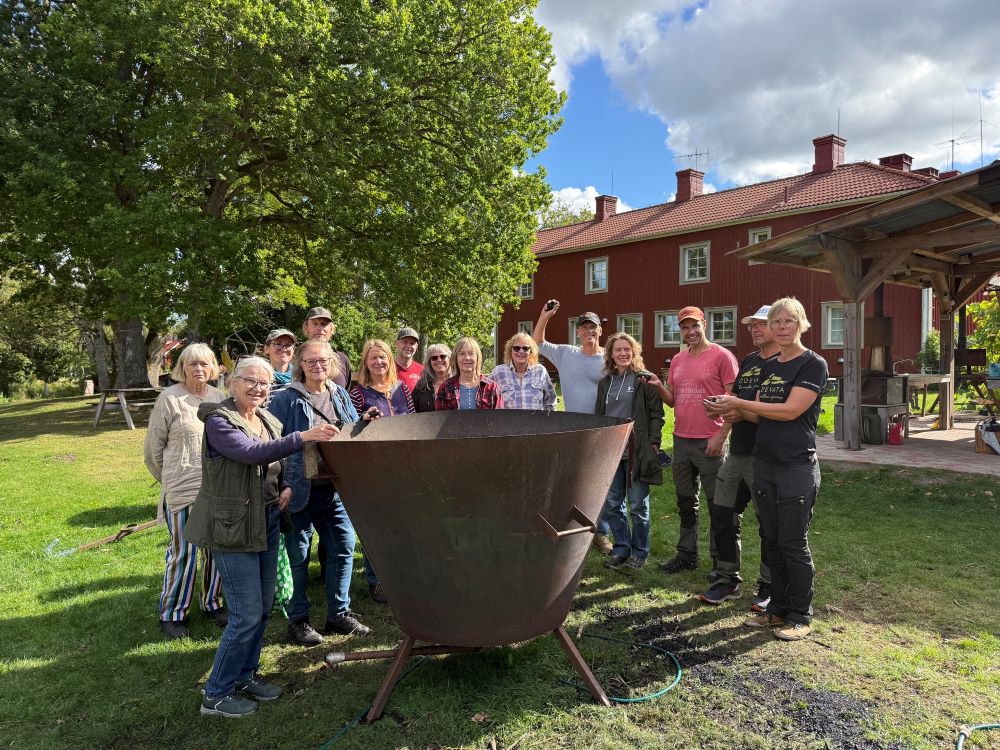
Together with Fobo Eksjö/Nässjö, the Odlingsakademien conducted a study trip to Ödevata outside Emmaboda, where we received both a tour of the crops, forest garden, and greenhouse as well as a workshop in biochar.
Ödevata has a long history and has, among other things, been an open institution and work home in the 1920s, a refugee camp during World War II, and a correctional facility. When Malin and Magnus bought Ödevata in 2005, the facility had been empty for several years.
The couple created a farm hotel and has, alongside their work in the tourism industry, managed and developed the farm with a clear sustainability focus.
For several years, they have operated an impressive aquaponics facility, where fish and plants live in a closed system, with gravel or biochar in the growing beds, which never need to be replaced. The water is replaced once a year when new fish are added. A strategic decision to no longer heat the greenhouse in winter means that bananas, passion fruit, and papaya can no longer survive, but both figs and lemon trees thrive in the greenhouse.
Biochar is made from by-products from forests and gardens, that is, rice, branches, and twigs that are burned at high temperatures and in an oxygen-poor environment and extinguished from below with cold water. The result is a clean and extremely porous material. The finished charcoal is charged with nutrients (bokashi, urine, or fertilizer) to be used as soil improvement and can then distribute nutrients over a long time. The charcoal contributes to a sustainable cycle and builds a carbon sink for future generations.
Since 2017, biochar has been produced on the farm, and Magnus also manufactures and sells the conical burning barrel Kontiki, which is now used by everyone from private individuals to municipalities. Biochar is a central part of the operation, and Malin and Magnus are happy to share their experiences and knowledge about production and the benefits of biochar. Here are some areas of use:
- At the bottom of bokashi buckets, biochar absorbs nutrients
- At the bottom of bedding for animals, biochar absorbs nutrients
- In the outdoor toilet, where it is only allowed to urinate, the entire barrel under the seat is filled with biochar, which binds odor and takes care of the nutrients. The toilet is completely odor-free, even though the barrel is not emptied for several months.
- Stores root vegetables in biochar; if something rots, the biochar takes care of it.
- Soil improvement and soil factory for the already charged charcoal
- Long-term fertilization and carbon sink in the growing beds
- Filters gray water and rainwater
- Feed supplement for the animals
- In building preservation projects
Do you want to learn more about biochar? On Friday, October 23, the Odlingsakademien is organizing a biochar after work at Maria Andersson and Grind Lönneberga, in Saxemåla, Hultsfred municipality. Read more here