At the grafting courses in Kristdala and Lidhem on 19/4 and 26/4, Björn Westeson shared some general knowledge about trees. When buying a new tree, it is best if it has branches evenly around the entire trunk, in a spiral shape upwards, so that not all branches originate from the same place. The pit you plant in should be well-sized and drained, for example through gravel in the bottom. Knock down 1-3 posts around the tree to give it support and use rodent protection. The spiral-shaped protection risks strangling the tree as it grows, better is netting that opens gradually or chicken netting that is attached so that it does not rub against the trunk. Remember not to plant the trees too closely, but plan so that the fully grown crowns can fit next to each other. Water thoroughly the first few years.
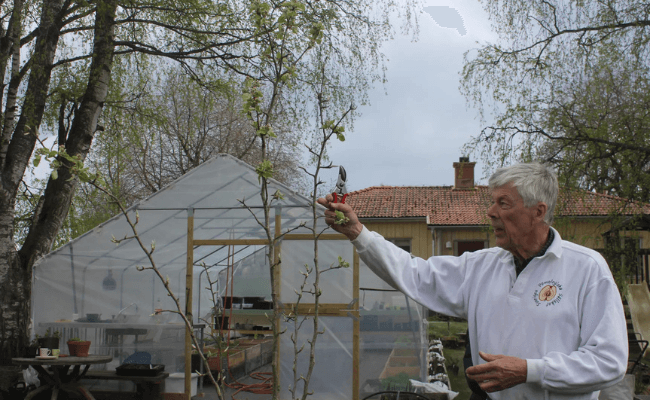
Björn demonstrated pruning during the course. Young trees do best when pruned during the winter months, while mature trees (about 5-6 years and older) are best pruned during summer and autumn. If you prune an older tree in winter, it will respond by producing a large amount of water shoots to compensate for the loss of leaf mass. In principle, a tree's root system is as large as its crown and it wants to maintain that balance. If a tree has been pruned heavily and has produced a lot of water shoots, they should be removed by a third at a time over a three-year period to avoid new water shoots. Young trees are pruned to create a good shape and stimulate growth.
The most active roots are found at the farthest end of the root system, which is why it is in the area below the outermost part of the crown, the drip line, that you should fertilize and aerate the soil.
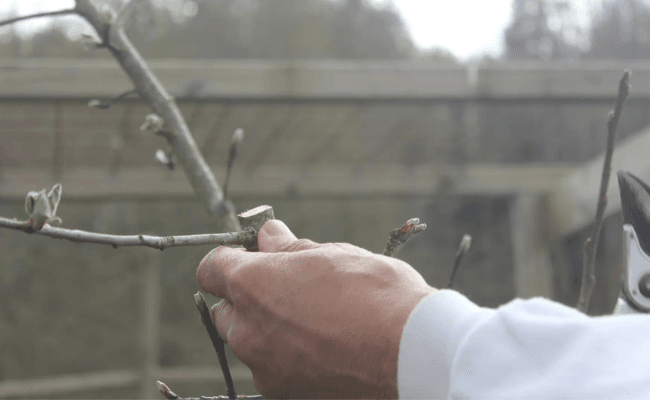
Branches are cut just above an outward branch or leaf bud. It is important not to damage the branch collar, but to leave a taproot that is too long. At first, the young tree will have a rather pointed shape, but then become flatter as it begins to produce fruit that weighs down the branches. No wax or balm is needed on these cut surfaces, they heal best in peace. New branches form on the top, so a good strategy is to prune from the bottom on slightly older trees, focusing on creating a light and airy crown. Do not cut branches larger than 10 cm in diameter. Björn also advises thinning to get the largest and healthiest fruit.
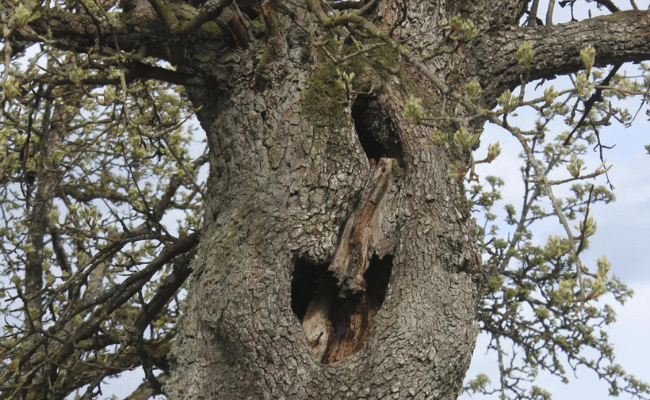
Save old trees as long as they bear fruit, says Björn. It doesn't matter if they are hollow and rotten inside. The very life force of the tree is located just inside the bark, in the cambium. Don't plug the holes with anything either, but you may need to make a small hole at the bottom for drainage. Remove all trunk shoots and prune the tree to stimulate growth, but don't do it too hard at once. Let it take several years!
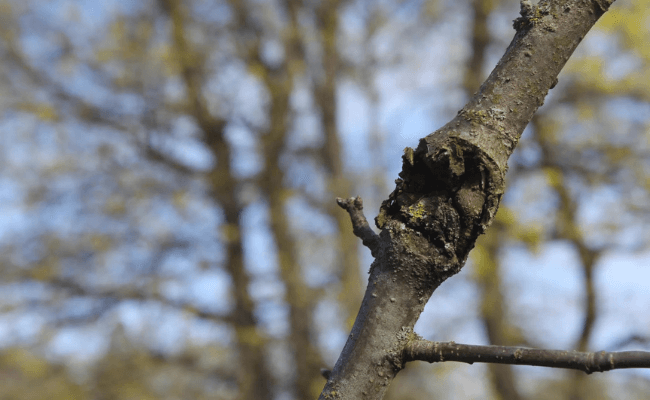
Björn also showed and told about fruit tree canker. It is a fungus that causes damage that is visible in the picture above and shortens the life of the tree. The risk of getting canker increases in clay soil, so drain properly when planting, for example by replacing part of the soil with sand, gravel and humus-rich soil. Damage to the bark and a humid climate also increase the risk. Protect the tree and keep the crown airy. Björn thinks you can save a tree with canker, but you should definitely not take grafting as the infection is present throughout the tree.
Thank you Björn for interesting and rewarding course days!