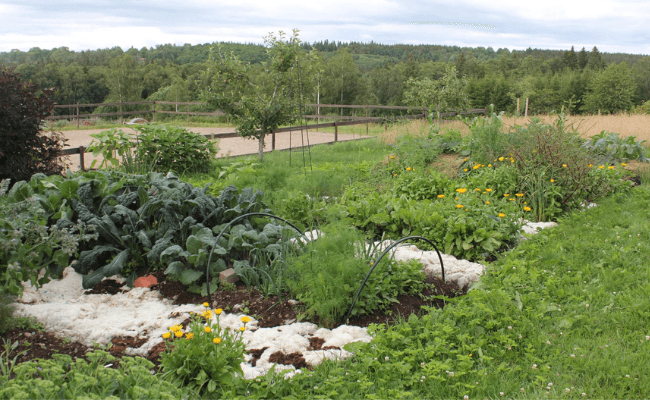
Something we have talked about a lot on the garden visits is how to create land and new soil. By using organic material from the site, you can create humus-rich cultivation areas that close the cycles and bind carbon in the soil, sometimes without digging at all. This is probably something everyone who has taken our courses has taken for granted, but it is not yet widespread knowledge among all growers. I have seen many beautiful hill beds on my visits, see this post for instructions on how to do it.
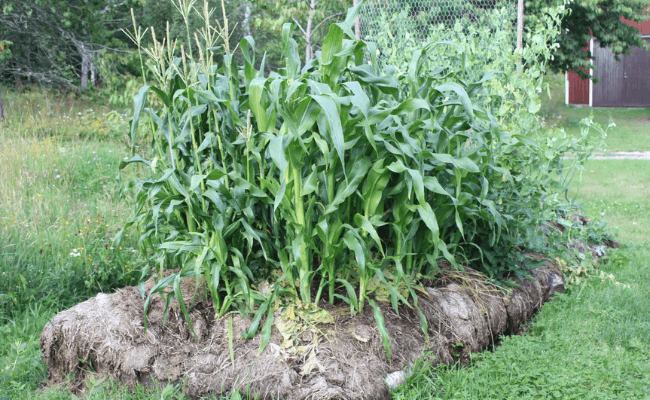
The hügel beds are built on logs, sometimes laid directly on newspapers or cardboard on the ground, sometimes buried a bit. Thick layers of other organic materials are placed on top. If you do not have access to logs, it is also possible to build beds with less coarse material at the bottom. Compost loaves similar to the hügel beds but only have rice and branches at the bottom. These are often quite high, and then collapse when the material is composted. Here are pictures of compost loaves. With a smaller amount of branches at the bottom, the beds can be called lasagna beds, because they are built up by layering different materials just like a lasagna. The lasagna bed is usually not as large as the compost loaf and can be created inside a pallet collar or similar. Coarser materials should be closer to the bottom and lighter materials higher up. To grow in the beds, you make holes with soil for the plants or add a layer of soil on top of the new bed.
All of these techniques are superb in that they transform ”waste” into fantastic soil. This can be old silage, weed cuttings, branches from pruning, autumn leaves, manure… It is good to try to balance the amount of carbon and nitrogen, where carbon should account for the largest part. Carbon-rich materials are often brown or yellow, such as logs and branches, straw, withered autumn leaves, etc., while nitrogen-rich materials are usually green, such as grass clippings or silage. The exceptions are manure and ”gold water” (diluted urine), which are both rich in nitrogen.

There are no exact ”recipes” for baking compost loaves or the like, but the point is to use what is available on site. The thickness/height of the beds is determined by which variant you use, how much material is available and how thick the topsoil layer is under the bed.

Another way to build new countries is using potatoes. Either without digging by growing the potatoes in silage or straw on top of the lawn or by digging furrows and at the same time combating rotograss.
In the aisles between the beds you can have grass, perhaps wide enough for a rabbit or chicken coop?, bare soil or some form of covering material such as sheep wool, used shavings, wood chips or bark, perhaps with newspapers or cardboard underneath. Covering material has the advantage that it contributes to reducing weed pressure and helps retain water in the soil. If you use organic material, it will be a good soil improvement when it has broken down. Preferably use what is available in the local area and is otherwise seen as "waste".
The soil in the growing beds also benefits from being covered with organic material, preferably all year round. See this post about winter bedding in the garden. Cover crops are also a variant of composting, just like hill beds, compost loaves and lasagna beds, but it is called surface composting. Here is one of many pages where you can read more about cover crops.
This was a quick overview of some different ways to create new growing areas, but there is of course infinitely more to write about the topic. Feel free to share important insights and knowledge (or questions!) you have gained from building new growing beds! Either by commenting on the post or emailing us material for your own post.
Growing in sand
On some of the garden visits we have talked about growing in sand, which works perfectly. The advantage is that you can use the same ”soil” year after year without suffering from soil fatigue or soil-borne diseases and that plants can grow in harsher growing climates than normal, due to the sand’s draining and heat-retaining ability. The sand used should be 0-8 mm. Since sand does not contain nutrients, it can be added in the form of grass clippings and nutrient solutions, such as nettle water or golden water. It is important to keep the grass clippings moist so that the decomposition, and thus the supply of nutrients to the bed, works. When sowing, it can be easier to add a little seed soil in the rows. Here You can read more about growing in sand.

If you want to grow in sand over the winter and/or early spring, you need to think a little extra about watering and fertilizing already the autumn before. Save grass clippings in black garbage bags and perhaps prepare fertilizer water/nutrient solution.